Neural Markers of Fragile X: A Powerful New Tool for Clinical Trials

Recruiting: BRIDGE Study (BRain Indicators of Developmental Growth)

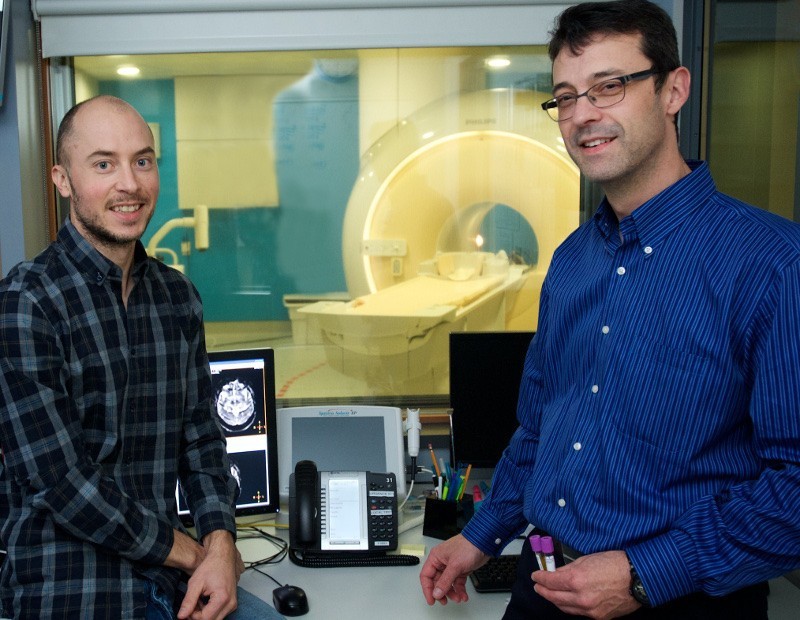
This study from the Wilkinson Lab at Boston Children’s Hospital is investigating how differences in brain activity affect learning, language and behavior in children with Fragile X syndrome, Down syndrome, and Autism Spectrum Disorder. One of the goals is to find brain markers that predict cognitive, language, and behavioral difficulties in these groups. Another goal is to better understand the differences in brain activity between young children with and without Fragile X and Down Syndrome, and whether these differences are similar in children with Autism Spectrum Disorder.

Read More »

Clinical Study of Non-Invasive EEG for Children Ages 2-7

Dr. Carol Wilkinson, MD PhD at Boston Children’s Hospital is recruiting children ages 2-7 years with Fragile X syndrome to participate in a study of EEG.

Read More »

Meet Archie!

Meet #FriendofFRAXA Archie! If you would like to nominate someone as a #FriendofFRAXA, we welcome all who have been touched by Fragile X, including friends, grandparents, siblings, professionals and companions alike to become a #FriendofFRAXA with the goal of putting a face to Fragile X for those who may not know someone directly.

Read More »
Banerjee team at College of Staten Island

Correcting Fragile X Syndrome Deficits by Targeting Neonatal PKCε Signaling in the Brain

Enhancing PKCε in early development normalized oxytocin, AMPAR signaling, and adult behavior in Fragile X mice, highlighting PKCε as a promising therapeutic target.

Read More »
LEPAGE_jean-francois_CORBIN_francois

Lovamix: Clinical Trial of Combined Treatment of Minocycline and Lovastatin in Fragile X Syndrome

FRAXA funded the LovaMiX trial of lovastatin + minocycline for Fragile X. 2022 results show safety and support continued study of this dual-target treatment approach.

Read More »
Frank Kooy lab

GABA-A Receptor in Fragile X Syndrome

Published results from Dr. Frank Kooy reveal how GABAA receptor changes may hold the key to treating Fragile X syndrome.

Read More »

Characterization of a Novel CYFIP1 – Derived Peptidomimetic Restoring the Dysregulated mRNAs Translation: Toward An Innovative Therapeutic Strategy for FXS

This team is designing tiny “peptidomimetic” drugs that mimic FMRP’s function to rebalance protein production in the brain, aiming to treat Fragile X at its source.

Read More »

Purposeful and FRAXA Partnership Leads to Clinical Trial

AI and FRAXA-DVI identified a drug + supplement combo that reversed all Fragile X symptoms in mice. A clinical trial tested this in adults with Fragile X.

Read More »

Inhibiting Nonsense – Mediated mRNA Decay: A Potential Treatment Approach for Fragile X

This team previously discovered runaway nonsense-mediated mRNA decay (NMD) in cells of Fragile X patients. They will now test drugs to reduce NMD.

Read More »

Exploring Drug Repurposing to Restore Hippocampal Function in FXS Mouse Models

This team found a key mechanism by which FMRP controls brain connections. They’ll test existing drugs that target this pathway to restore learning and memory in Fragile X.

Read More »

Contribution of Microglia to the Therapeutic Effects of Metformin and Adiponectin in Fragile X Syndrome

Why are some with Fragile X always hungry or overweight, yet rarely diabetic? This team is studying metabolism and testing treatments like metformin and diet.

Read More »

Promising Results of Preclinical Study of ANAVEX®2-73

We are excited to share that Anavex Life Sciences announced today that preclinical data of the ANAVEX®2-73 (blarcamesine) study in Fragile X syndrome were published in the peer-reviewed journal, Scientific Reports.

Read More »
Fragile X Clinical Trials

Synaptogenix Announced Intention to Launch a Fragile X Clinical Trial with Bryostatin

Bryostatin research has advanced from mouse models to human trials. Synaptogenix and Nemours make plans to test this potential treatment in Fragile X clinical trials.

Read More »

Link Between Lipid Profile, eCBome System and Gut Microbiome in Fragile X Syndrome

Why does obesity challenge so many people with Fragile X? Dr. Caku’s team has found that Fragile X syndrome causes changes in the tiny organisms that live in our gut.

Read More »

Characterization of Microglia Transcriptional Profile in Fmr1 Knockout Mice Model

Microglia are excessively activated in Fragile X models. The team will investigate the mechanisms and attempt to correct this using drugs.

Read More »

The Role of Astrocyte BMP Signaling in Fragile X Syndrome

Researchers found a pathway in astrocytes that is overactive in Fragile X syndrome, and they hope to bring this pathway back to normal with a drug.

Read More »

Preclinical Testing of High Fat/Low Carb Diets in Fragile X Mice and Cells

Dr. Cara Westmark’s team will use mice to determine if palatable Atkins-type diets can improve sleep and boost learning skills for those with Fragile X syndrome.

Read More »

Pivotal Phase 3 Trial of Zygel in Severe Fragile X Possible This Year

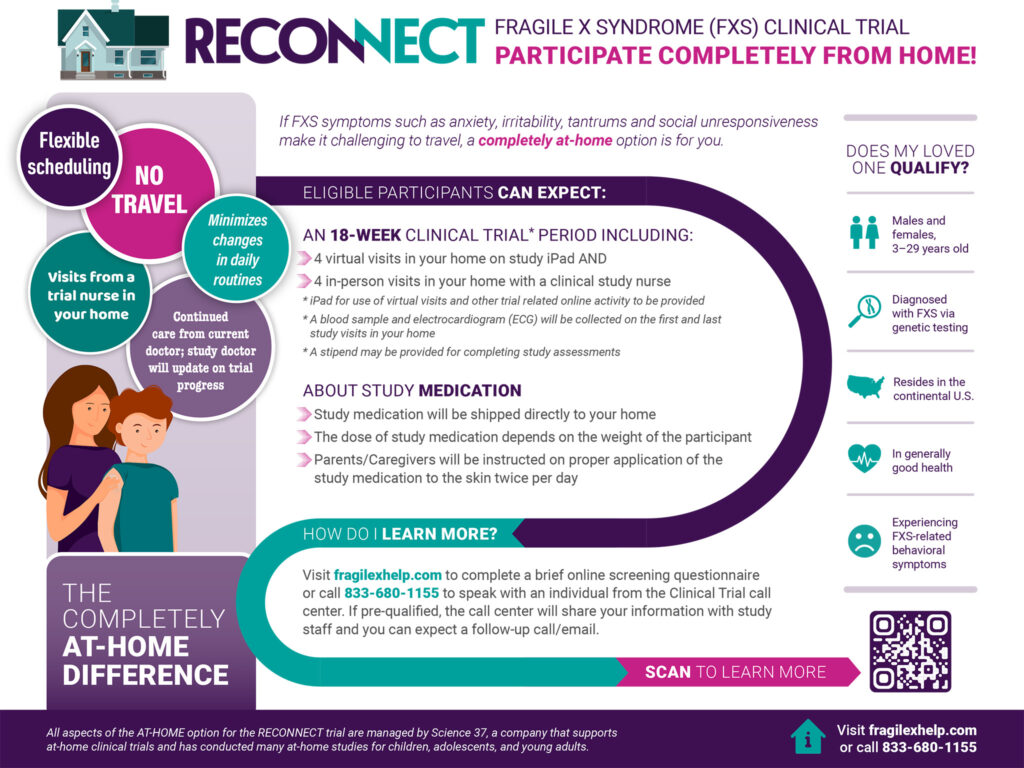
Zynerba Pharmaceuticals reported receiving advice from the U.S. Food and Drug Administration (FDA) on the design of an upcoming Phase 3 clinical trial meant to confirm previous trial findings supporting  Zygel as a cannabidiol treatment in a specific subset of Fragile X syndrome patients. The new trial, called RECONNECT, is expected to launch before October, and will mainly enroll children and adolescents with a complete (100%) methylation of FMR1, the gene mutated in Fragile X.

Read More »

Pharmacotherapeutic Effects of Cannabidiol (CBD) in Fragile X syndrome (FXS) and Autism Spectrum disorder (ASD)

This study tested CBD (cannabidiol) treatment in male and female Fragile X mice to learn how and why it works and whether gender affects responses to CDB treatment.

Read More »

Cellular-Specific Therapeutic Targeting of Inhibitory Circuits in Fragile X Syndrome

The team studied how inhibitory brain circuits malfunction in Fragile X and tested ways to restore balance by targeting mGluR and endocannabinoid signaling.

Read More »
Elizabeth MCullough and Achim Klug

Auditory Dysfunction in Fragile X Syndrome in a Mouse Model of Fragile X

FRAXA-funded studies found Fragile X mice show altered auditory circuit function with delayed startle timing and reduced prepulse inhibition, mirroring human sound sensitivity.

Read More »
Screening Combinatorial Pharmacological Therapies for Fragile X Syndrome

Screening Combinatorial Pharmacological Therapies for Fragile X Syndrome

This Stanford University team assessed combinatorial drug treatments to correct a broad spectrum of deficits observed in Fragile X syndrome. Results published.

Read More »

Parkinson’s Therapy May Hold Promise for Fragile X

A study funded by FRAXA in Italy has encouraging results for people with Fragile X: drugs that block adenosine receptors (A2A) reversed signs of Fragile X in a mouse model. 

"One of the most intriguing things about this study is that it points to an entire drug class (not just the one drug used) as potentially therapeutic for Fragile X. Many available compounds block A2A receptors, and we know they are safe and effective.

Read More »

Beneath the Surface of Fragile X Syndrome: Study Sheds Light on What’s Happening in Nerve Cells

This FRAXA-funded project has turned up some surprising results. At first, it might seem Kurosaki and Maquat have found yet another cellular process which is malfunctioning in Fragile X. But this finding is intimately related to previous findings of abnormal protein synthesis and misregulated transcription in Fragile X. FMRP (the protein lacking in Fragile X syndrome) is involved in chaperoning messenger RNAs within cells to active sites, and in controlling their translation into many different proteins. Some of these proteins are transcription factors, which feed back to the nucleus to control gene expression.

Read More »

Categories

FRAXA Funded Research

Current Research Grants (37)