Discovery and Therapeutic Correction of Neurodevelopmental Splicing Defects in Fragile X Syndrome Using Human Brain Models
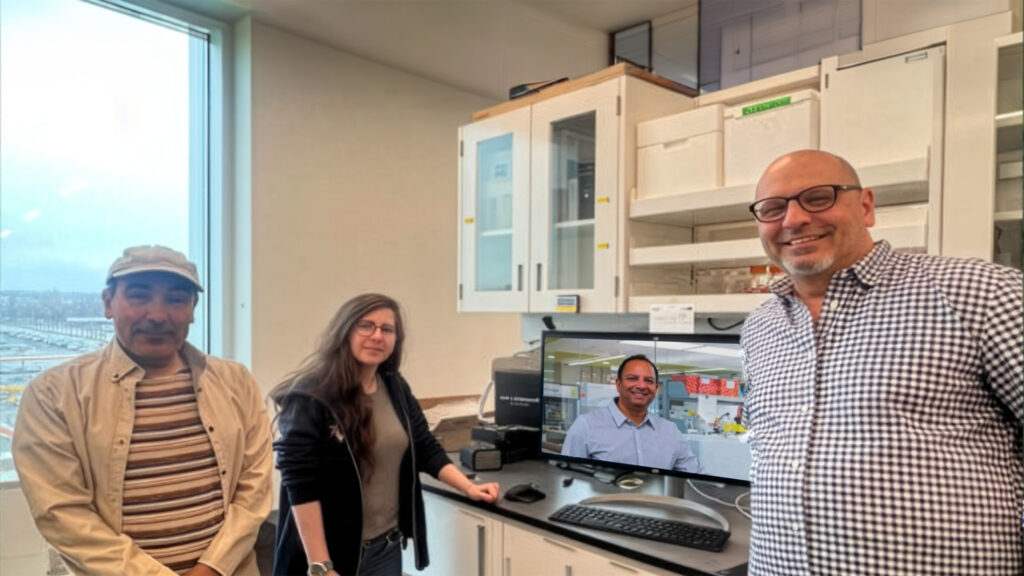
Rachid Mazroui, PhD
Principal Investigator
Emeline Lelong, PhD
FRAXA Postdoctoral Fellow
Samer Mohamed Hussein, PhD
Co-Principal Investigator
Karun Singh, PhD
Co-Principal Investigator
Laval University
Quebec, Canada
2026-2027 Grant Funding: $100,000
Summary
This team will investigate how errors in RNA splicing contribute to fragile X syndrome during early brain development. Using advanced sequencing methods in human brain organoids, the researchers will identify specific RNA isoforms affected by loss of FMRP and explore whether they can be corrected using antisense therapies (ASOs).
The results could point toward new treatment approaches that directly target underlying molecular changes in Fragile X.
The Science
By Rachid Mazroui, PhD; Emeline Lelong, PhD; Samer Mohamed Hussein, PhD; and Karun Singh, PhD
Recent research shows that alternative RNA splicing, the process by which a single gene can produce multiple RNA versions, or isoforms, plays a critical role in brain development, neurogenesis, neuronal activity, and long-term brain function. Changes in RNA splicing have been linked to several neurological conditions, including amyotrophic lateral sclerosis, Alzheimer’s disease, Parkinson’s disease, autism spectrum disorder, and intellectual disability. Importantly, recent studies show that widespread mis-splicing occurs in the brains of Fmr1-deficient mice, suggesting that abnormal RNA splicing during early brain development may contribute directly to Fragile X syndrome (FXS).
Although modern RNA sequencing methods have helped identify important transcriptional and translational changes in Fragile X syndrome, most previous studies relied on short-read sequencing technologies that cannot fully detect the many different isoforms produced in the developing brain. As a result, a large portion of RNA isoform diversity in FXS remains unexplored.
In this project, we will use human brain organoid models, laboratory-grown miniature brain-like structures derived from stem cells, to study how RNA splicing changes during early cortical development in Fragile X syndrome. Using an advanced technique called single-cell long-read RNA sequencing, we will identify specific RNA isoforms that are altered during early neurogenesis. Because the cerebral cortex is one of the brain regions most affected in Fragile X syndrome, understanding isoform diversity in this region is especially important.
This work will generate the first dataset of its kind describing isoform-level changes at single-cell resolution during early human cortical development in Fragile X syndrome. We will then test whether some of these altered isoforms can be corrected using antisense oligonucleotides, or ASOs, an emerging therapeutic approach that can adjust RNA processing directly.
Together, these studies may identify new treatment strategies aimed at correcting RNA splicing defects downstream of FMRP loss. By defining which RNA isoforms are altered early in brain development, this project could open a new path toward therapies that target the underlying biology of Fragile X syndrome.