
Combinatorial Drug Treatment in a Model of Fragile X Syndrome using Novel Biomarkers
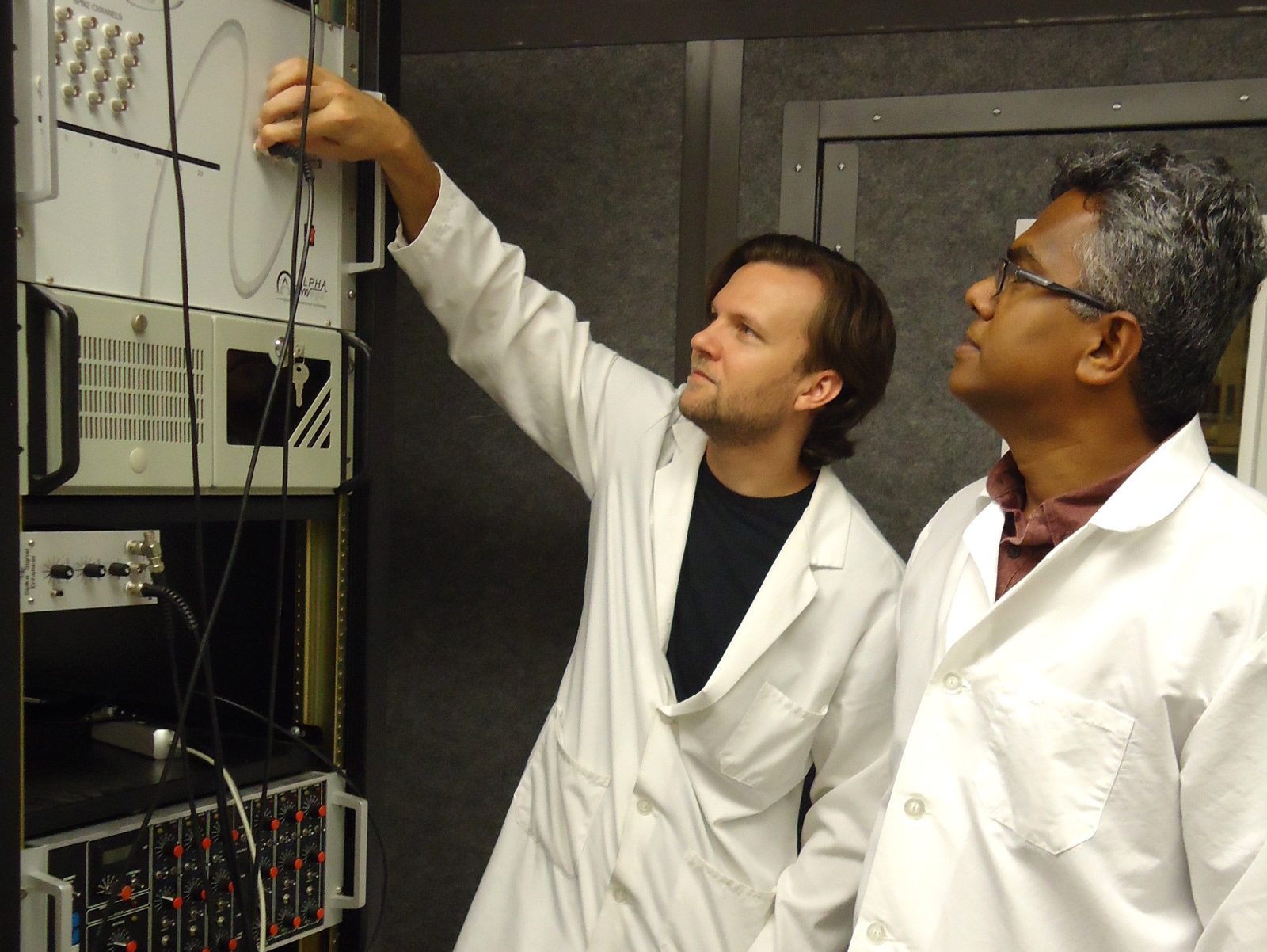
Khaleel Razak, PhD
Principal Investigator
Jonathan Lovelace, PhD
FRAXA Fellow
University of California, Riverside
Riverside, CA
2016-2017 Grant Funding: $90,000
Summary
With a $90,000 grant from FRAXA Research Foundation awarded over 2016-2017, University of California researchers Khaleel Razak, PhD, and Jonathan W. Lovelace, PhD, are exploring drug combinations to limit hypersensitivity to sounds in Fragile X mice.
The Results
Results Reported:
The Fragile X field needs reliable, unbiased, and relevant biomarkers to assess potential treatments, first in mice and then for human patients. One of Dr. Lovelace and Dr. Razak’s most important discoveries is a striking similarity in EEG biomarkers between mice and humans. They published a 2018 paper describing sound-driven EEG biomarkers in Fragile X mice. The consensus of basic scientists and clinicians who work with individuals with Fragile X syndrome at Cincinnati Children’s Hospital is that FMR1-KO mice and humans with the syndrome have larger than normal brain responses to sounds, and also that both mouse and human responses are more noisy and less consistent.
The Science
With this grant, we have expanded our work in anesthetized mice to auditory evoked responses of the auditory cortex in awake freely moving mice which have been bred to mimic Fragile X syndrome. While these experiments are more difficult to perform, they offer a more translatable outcome measure when compared to humans with FXS, since anesthesia can alter responsiveness of sensory systems and generally eliminate top-down mechanisms of sensory perception.
We next sought to test our EEG outcome measures on candidate drugs to reverse EEG biomarkers which include: CTEP (mglur5 antagonist) and Minocycline (tetracycline derivative which is thought to act through inhibition of MMP9).
At the same time, we have been developing behaviors assays in the lab (Open Field, Elevated Plus Maze, and Novel Object Recognition) with the goal of relating EEG outcome measures to behavioral outcomes. This will allow us to use both behavior and EEG measures to test the effectiveness of drug treatments, but also gives insight into analyzing drug-responders vs non-responders on these different measures. This new information could allow prediction of drug responsiveness based on objective physiological measures before drug administration, a potentially powerful tool for clinical research moving forward.