FRAXA-DVI Study Finds Promising Results for Marvel Biosciences’ A2A Receptor Drug in Fragile X Model
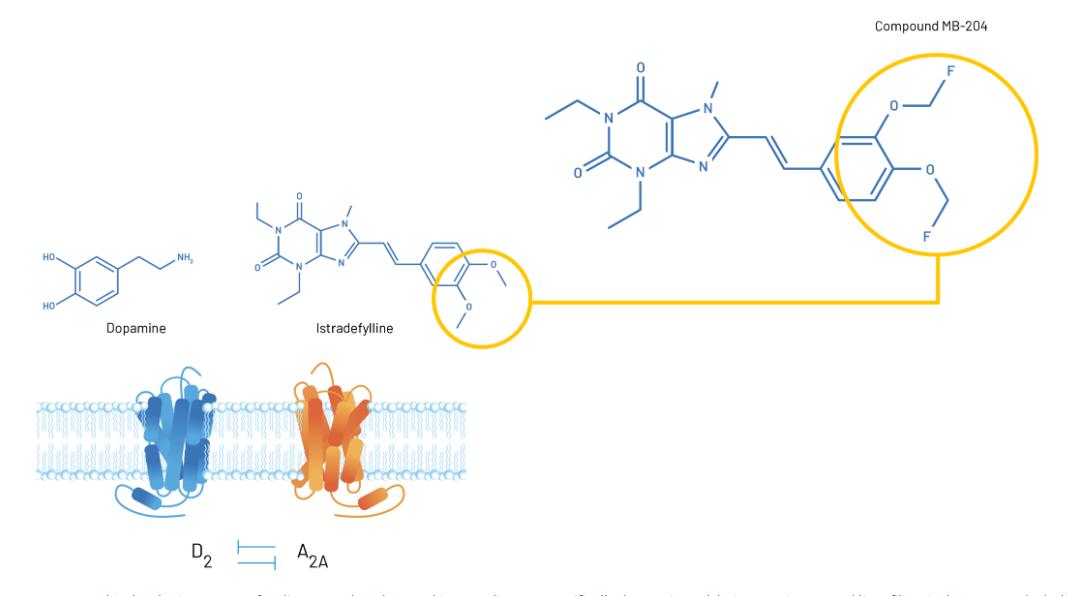
Marvel Biosciences has just announced encouraging evidence that MB-204, a drug that blocks adenosine A2A receptors, can improve behavioral and cognitive deficits in a Fragile X syndrome mouse model. The study was conducted at the FRAXA Drug Validation Initiative (FRAXA-DVI), FRAXA’s preclinical testing program in Chile.
These results emerged from previous FRAXA-funded research by Drs. Alberto Martire and Antonella Borreca in Italy. The team showed that blocking A2A receptors could normalize altered brain signaling and improve cognitive and other features of Fragile X in mice. Caffeine is also an A2A receptor antagonist though not as potent or selective as Marvel’s compounds. Nonetheless it is the most widely used psychoactive substance in the world and is generally recognized as safe. This makes us wonder if we in the Fragile X community should be avoiding caffeine.
Building on that foundation, Marvel Biosciences then partnered with FRAXA to test MB-204, a next-generation A2A receptor blocker, at FRAXA-DVI.
Since 2011, FRAXA-DVI has evaluated promising new and repurposed drugs in validated Fragile X models, helping researchers and companies identify the strongest candidates to advance toward clinical development.
The positive findings announced today are an important preclinical step toward determining whether MB-204 can benefit individuals with Fragile X syndrome.
Marvel Biosciences Reports Positive Preclinical Data Demonstrating MB-204 Reverses Behavioural and Cognitive Deficits in a Mouse Model of Fragile X
Source: Marvel Biosciences, “Marvel Biosciences Reports Positive Preclinical Data Demonstrating MB-204 Reverses Behavioural and Cognitive Deficits in a Mouse Model of Fragile X,” August 5, 2026.
Calgary, Alberta – August 5, 2026 – Marvel Biosciences Corp. (TSXV: MRVL | OTC: MBCOF), and its wholly-owned subsidiary, Marvel Biotechnology Inc. (collectively the “Company” or “Marvel”), a drug discovery company developing novel therapeutics for autism spectrum disorder and related conditions, is pleased to announce positive results from its preclinical Fragile X study conducted through the FRAXA Drug Validation Initiative in collaboration with the FRAXA Research Foundation.
This announcement represents another significant milestone in the continued de-risking of Marvel Biosciences’ lead drug candidate, MB-204. By demonstrating statistically significant improvements in both behavioural and cognitive function in a Fragile X mouse model, including durable carry-over effects after treatment ceased, MB-204 has now generated compelling efficacy data across three independent preclinical models of autism spectrum disorder (ASD), including Rett syndrome (Mecp2), the Oprm1 model of ASD, and now Fragile X syndrome (Fmr1). Collectively, these results further strengthen the scientific foundation supporting MB-204’s advancement toward clinical trials while expanding its potential commercial opportunity across multiple orphan neurological indications with significant unmet medical need.
Fragile X syndrome (FXS) is the most common inherited cause of intellectual disability and one of the most common single-gene causes of autism spectrum disorder. It is caused by mutations in the FMR1 gene on the X chromosome. As males have only one X chromosome, they are typically more severely affected than females. Current epidemiological studies estimate that FXS occurs in approximately 1 in 7,000 males and 1 in 11,000 females in the general population and as such it qualifies as an orphan disease in both the United States and Europe.
The study was conducted through the FRAXA Drug Validation Initiative (FRAXA-DVI), an independent program that evaluates promising therapeutic candidates for Fragile X syndrome. The study evaluated MB-204, Marvel’s lead compound, in low- and high-dose treatment groups administered orally once daily in FMR1 knockout (KO) mice. FMR1 mice were treated for approximately two weeks and subjected to a standard battery of model-specific behavioural and cognitive tests, then retested two weeks after treatment ceased to study the carry-over effect of the drug.
Overall, MB-204 restored every behavioural and cognitive endpoint studied in Fragile X mice toward wild-type (normal) levels, including improvements in novel object recognition (cognition), open-field test (locomotor activity), self-grooming (stereotypy), nesting (hippocampal dependent activity of daily living), hyphoneophagia (anxiety). Key highlights included:
After Two Weeks On Treatment:
- MB-204 produced clear dose-dependent behavioural effects in the Fmr1 knockout mouse on every endpoint, with the high-dose group showing the strongest and most consistent efficacy.
- Animals receiving the high-dose treatment generated response patterns statistically consistent with wildtype-like performance (WT) in open-field test activity, self-grooming, nesting and hyponeophagia (p<0.0001 vs KO vehicle), although nesting remained different from WT.
- The low-dose group produced significant but non-WT-like effects in open field, self-grooming and hyponeophagia (p<0.0001, p<0.017 and p<0.0001 vs KO vehicle, respectively) but had no detectable effect on nesting.
- Both treatment groups restored novel-object discrimination (p<0.0001 for both doses), demonstrating significant improvement in recognition memory, a key measure of cognitive function.
After Two Weeks Off Treatment (Carry-Over Effect):
- The high-dose treatment group retained significant effects relative to KO vehicle in open field (p=0.003) and self-grooming (p=0.0015), although these responses were attenuated and no longer WT-like.
- The high-dose group also retained significant novel-object discrimination when tested with a completely different object set (p=0.0052), supporting a persistent recognition-memory effect rather than simple memory for the original objects.
- Overall, results support robust on-treatment efficacy and a measurable, though reduced, post-washout effect in the high-dose treatment group, while the low-dose treatment was insufficient to produce a durable post-treatment benefit.
“This is now the third ASD model and second independent group that has demonstrated the potential of MB-204 to restore behavioural and cognitive function to near normal levels in mice regardless of the genetic cause of the neurodevelopmental disorder” commented Dr. Mark Williams, CSO of Marvel Biosciences. “We also confirmed a carry-over effect in a second model, suggesting MB-204 has a very attractive target product profile. We are very grateful to FRAXA for this collaboration and look forward to advancing MB-204 to the clinic”.
This latest preclinical success in Fragile X syndrome marks the third autism-related model in which MB-204 has demonstrated the ability to restore behavioural and cognitive function toward normal levels, providing further validation of the drug’s mechanism of action and strengthening the Company’s core investment thesis. Combined with previously reported positive results in the Rett syndrome (Mecp2) and Oprm1 ASD models, these findings continue to build a compelling preclinical package supporting the advancement of MB-204 toward clinical trials. The Company has also completed preclinical evaluation of MB-204 in a Shank3 model of Phelan-McDermitt syndrome and is awaiting final statistical analysis of the results. Marvel expects to report those results in a future announcement.
About Marvel Biosciences Corp.
Marvel Biosciences Corp. through its wholly-owned subsidiary Marvel Biotechnology Inc., is a Calgary-based biotechnology company developing new treatments for neurological diseases and neurodevelopmental disorders. Our lead drug candidate, MB-204, is a novel fluorinated derivative version of Istradefylline, an approved Parkinson’s drug and the only adenosine A2A receptor blocker currently on the market. Research shows that blocking the A2A receptor may help treat conditions such as autism, depression, and Alzheimer’s disease. Marvel is also exploring MB-204’s potential in rare disorders like Rett syndrome and Fragile X syndrome, aiming to bring new options to patients with few effective treatments.
Contact Information: Marvel Biosciences Corp.
J. Roderick (Rod) Matheson, Chief Executive Officer Email: rod@marvelbiosciences.com
Dr. Mark Williams, President and Chief Science Officer Email: mark@marvelbiosciences.com
Tel: 403 770 2469
Website: www.marvelbiotechnology.com