What Is Fragile X Syndrome?
Fragile X syndrome (FXS) is the most common inherited cause of autism and intellectual disabilities worldwide.
Fragile X syndrome is a genetic disorder that occurs when a mutation disrupts a single gene on the X chromosome, called FMR1. Typically FMR1 makes a protein needed for normal brain development. In FXS it does not work properly, the protein is not made, and the brain does not develop as it should.
FXS can affect both sexes. Females generally have milder symptoms than males, although there is a lot of variation and no good way to predict this. While most males have intellectual impairment, only one-third of females have significant intellectual challenges. The rest have either normal IQ or learning disabilities. Math is often a particular challenge for females. Emotional and behavioral problems are common in both sexes.
Both boys and girls may have delays in learning to speak, but most individuals with Fragile X are verbal. Lifespan for people with Fragile X syndrome is generally normal. Most affected people have active lifestyles and good health.
FRAXA Research Foundation is working to find specific treatments and ultimately a cure for Fragile X, but at present, there is no cure. Most males and many females with Fragile X syndrome are significantly affected throughout their lives. The cost to society for treatment, special education, and lost income is staggering. The need for research aimed at treatment is urgent.
Symptoms of Fragile X Syndrome
Intellectual disabilities, ranging from mild to severe.
Attention deficit and hyperactivity, especially in young children.
Anxiety and unstable mood.
Autistic behaviors, such as hand-flapping and not making eye contact.
Sensory integration problems, such as hypersensitivity to loud noises or bright lights.
Speech delay, with expressive language more severely affected than receptive language.
Seizures (epilepsy) affect 10% to 20% of people with Fragile X syndrome. 2021 study published
Physical Signs of Fragile X Syndrome
These features may be hard to recognize in babies and young children, but sometimes become more apparent with age. Not everyone with Fragile X has all these signs.
Long face, large prominent ears, flat feet.
Hyperextensible joints, especially fingers.
Low muscle tone.
Males may have large testes after puberty.


Prevalence and Inheritance of Fragile X Syndrome
Sources do not agree on the prevalence of Fragile X syndrome, but recent estimates suggest 1 in 2,500 – 4,000 males and 1 in 7,000 – 8,000 females have FXS.
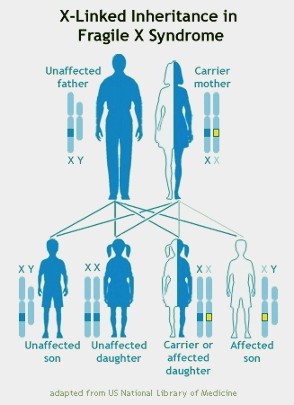
The Fragile X premutation can be passed silently down through generations in a family before a child is born with the syndrome.
Women who carry Fragile X
Have a 50% chance of passing the mutated gene to each of her children. If she passes the affected gene, her children will either be carriers or they will have Fragile X syndrome.
Men who carry Fragile X
Will pass the premutation to all their daughters but none of their sons. These daughters are carriers but they do not have Fragile X syndrome.
Want the genetics behind premutation vs. full mutation? Learn what causes Fragile X.
Fragile X and Autism
About 46% of males and 16% of females with Fragile X also have autism spectrum disorder (ASD) according to the CDC. Most boys and some girls have some symptoms of autism, but many are sociable and interested in other people. The key difference between the two disorders is that Fragile X is diagnosed by blood test and autism is diagnosed using a checklist of behaviors.
Treatment of Fragile X Syndrome
There are many helpful educational and behavioral strategies, as well as Occupational Therapy (OT), Physical Therapy (PT), and Speech Therapy (SLP), to help. An extensive array of medications is available to manage symptoms.
FRAXA-funded research has achieved significant breakthroughs, bringing us closer to finding new treatments.
There is hope.
We know that the Fragile X protein’s normal role is to help shape the connections between neurons (brain cells) that underlie learning and memory. Because absence of FMR protein delays the development of neurons, rather than destroying them, it is likely that treatments now being investigated will benefit all individuals with Fragile X, regardless of age.
Additional Resources About Fragile X Syndrome
Fragile X Clinics
Find clinics and specialists near you.
Medication Guide for Fragile X
Parent-friendly guidance to discuss Fragile X syndrome treatment options with your physician.
Fragile X Clinical Trials
See studies recruiting now and how to participate.
Treatment and Medication
Medication Options: Dr. Tranfaglia’s Recommended Combination
By Dr. Michael Tranfaglia, MD, FRAXA co-founder, Medical Director, and Chief Scientific Officer. His perspective on symptom management options for Fragile X.
Education and School Supports
Early Intervention (Ages 0–3)
Services that support development during the earliest years.
Individualized Education Plan (IEP)
School supports that help meet learning needs.
Classroom Strategies for Fragile X
A teacher-focused video with practical tips and downloadable slides.
Community and Family Support
Parent-Run Fragile X Facebook Group
Connect with other families in a large peer community.
#FriendofFRAXA Family Stories
Stories and updates shared by families and supporters.
 |
Fragile X News Today A Bionews site, provides clear, reliable news, research updates, and real-world perspectives to help people living with Fragile X syndrome and their caregivers feel more informed, confident, and supported throughout their care journey. Information is not meant to replace or provide medical advice. |